Class 16: Dynamics on Networks 1 — Diffusion and Random Walks#
Goal of today’s class:
Introduce dynamics on networks
Define random walk dynamics
Explore core results in random walks on networks
Acknowledgement: Some of the material in this lesson is based on materials by Matteo Chinazzi and Qian Zhang.
Come in. Sit down. Open Teams.
Find your notebook in your /Class_16/ folder.
import networkx as nx
import numpy as np
import matplotlib.pyplot as plt
from matplotlib import rc
rc('axes', axisbelow=True)
rc('axes', fc='w')
rc('figure', fc='w')
rc('savefig', fc='w')
Random walks in 1-dimension (not networks yet!)#
The concept of a random walk shows up all over the place in mathematics and across various scientific disciplines; the key insight is to use this notion as a tool to study processes where a system evolves based on a series of random, discrete steps. In this section, we begin with a formal definition of the 1-D random walker and examine key metrics such as expected displacement, variance, and probability distributions that characterize the walk’s dynamics over time.
Some good references:
Lawler, G.F. & Limic, V. (2010). Random walk: a modern introduction (Vol. 123). Cambridge University Press. https://www.cambridge.org/core/books/random-walk-a-modern-introduction/7DA2A372B5FE450BB47C5DBD43D460D2
Lovász, L. (1993). Random walks on graphs. Combinatorics, Paul Erdos is Eighty, 2(1-46), 4. https://www.cse.cuhk.edu.hk/~cslui/CMSC5734/LovaszRadnomWalks93.pdf
Consider a walker starting at an origin point \(y=0\) on a 1-D integer lattice, where each position on the lattice corresponds to an integer. At each discrete time step, \(t\), the walker either moves one step to up (\(y_{t+1} = y_{t}+1\)) or one step down (\(y_{t+1} = y_{t}-1\)), with equal probability, \(P(\textrm{move up}) = P(\textrm{move down}) = \frac{1}{2}\). (Note this can also be thought of as a 1-D line that the walker moves left or right on, but for visualization purposes, let’s use up/down.) This unbiased process is governed by a Bernoulli distribution, where each step is independent of the previous ones.
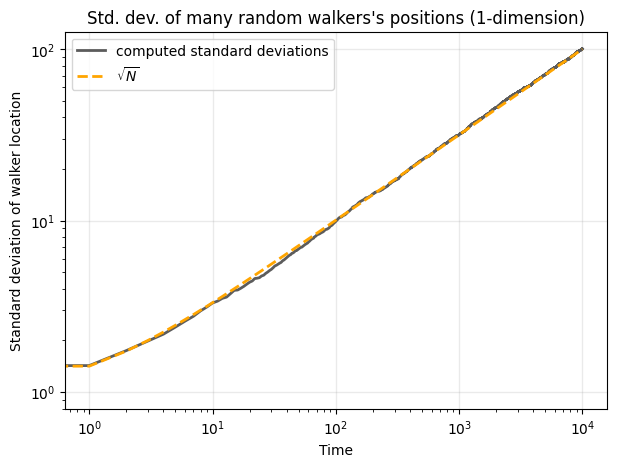
Let \(Y_t\) denote the position of the random walker at time \(t\). \(Y_t\) can then be written as the sum of \(t\) i.i.d. random variables \(\eta_i\), where \(\eta_i\) corresponds the outcome at each step (i.e., \(\eta_i = \pm 1\)), \(Y_t = \sum_{i=1}^t \eta_i\). The expectation of \(\eta_i\) is 0, and its variance is 1. Therefore, the expected position of a given random walker at time \(t\) can be written \(E[Y_t] = t E[\eta_i] = 0\), and the variance of the walker’s position grows with \(t\) as \(\textrm{Var}(Y_t) = t \textrm{Var}(\eta_i) = t\).
As \(t \rightarrow \infty\), we see that the position of the random walker can be estimated by a normal distribution \(Y_t \sim \mathcal{N} (0, t)\) (see: the Central Limit Theorem), and as a result, the probability density over the walker’s position at large enough \(t\) is:
This behavior forms one of the key insights for building random walkers beyond one dimensions! In Physics, we often see it used for studying diffusion processes. In Economics or Finance, we can use it as a foundation for building models of the stock market. In Biology, we can think of it as the base for models of particle motion in a cell. And in Network Science, random walks can be used as the starting point for algorithms that characterize network connectivity or centrality, community structure, spectral properties, and more.
8-min challenge! Code a single random walker#
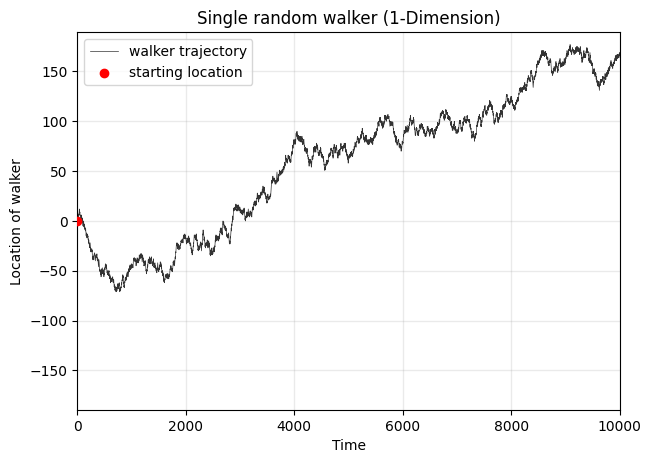
Let’s start the class off with a challenge. As defined above, code a single random walker, moving up and down with equal probability (\(p=0.5\)). Visualize this walker’s trajectory over 10,000 timesteps.
You’ve been given a starter-function single_1d_walkers below.
If you have time, adapt this to a general function that returns the trajectory for n_iter random walkers.
def single_1d_walkers(t=10000, start_position=0, p_up=0.5):
    """
    Simulates the path of a single random walker on a 1-dimensional lattice.

    Parameters
    ----------
    t : int, optional
        The number of steps the random walker will take.
    start_position : int, optional
        The starting position of the walker on the lattice. Default is 0.
    p_up : float, optional
        The probability that the walker takes an `up` step. 0.5 indicates
        an unbiased random walker.

    Returns
    -------
    positions_over_time: vector of ints
        A list-like object representing the positions of the walker at each
        step, starting from the initial position.

    Notes
    -----
    - At each step, the walker moves either +1 (up) or -1 (down) with equal
      probability.
    - This random walk is unbiased, with each step being independent of the
      previous one.

    Examples
    --------
    >>> random_walk_1d(5, start_position=0)
    [0, 1, 0, 1, 2, 1]
    """

    positions_over_time = np.zeros(t)

    pass


    return positions_over_time
Plot your walker below:
t = 10000
positions = single_1d_walkers(t)
fig, ax = plt.subplots(1,1,figsize=(7,5),dpi=100)

ax.plot(range(t),positions, lw=0.5, color='.2', label='walker trajectory')
ax.scatter(0,0,color='red',zorder=3,label='starting location')

ax.legend(loc=2)
ax.set_ylabel('Location of walker')
ax.set_xlabel('Time')
ax.grid(alpha=0.2, color='.6', lw=1)
ax.set_title('Single random walker (1-Dimension)')

ylims = ax.get_ylim()
ax.set_ylim(-np.abs(ylims).max(), np.abs(ylims).max())
ax.set_xlim(-1, t+1)


plt.show()
### my attempt!

up_prob = 0.5
probs = [up_prob, 1-up_prob]

timesteps = 10000
n_runs = 20

positions = np.zeros(timesteps)

for t in range(1, timesteps):
    positions[t] = positions[t-1]
    positions[t] += np.random.choice([1,-1], p=probs)
fig, ax = plt.subplots(1,1,figsize=(7,5),dpi=100)

ax.plot(range(timesteps),positions, lw=0.5, color='.2', label='walker trajectory')
ax.scatter(0,0,color='red',zorder=3,label='starting location')

ax.legend(loc=2)
ax.set_ylabel('Location of walker')
ax.set_xlabel('Time')
ax.grid(alpha=0.2, color='.6', lw=1)
ax.set_title('Single random walker (1-Dimension)')

ylims = ax.get_ylim()
ax.set_ylim(-np.abs(ylims).max(), np.abs(ylims).max())
ax.set_xlim(-1, timesteps+1)

plt.show()
Note on the implementation above: is there a faster way to do this?#
def single_1d_walkers(t=10000, start_position=0, p_up=0.5):
    """
    Simulates the path of a single random walker on a 1-dimensional lattice.

    Parameters
    ----------
    t : int, optional
        The number of steps the random walker will take.
    start_position : int, optional
        The starting position of the walker on the lattice. Default is 0.
    p_up : float, optional
        The probability that the walker takes an `up` step. 0.5 indicates
        an unbiased random walker.

    Returns
    -------
    positions_over_time: vector of ints
        A list-like object representing the positions of the walker at each
        step, starting from the initial position.

    Notes
    -----
    - At each step, the walker moves either +1 (up) or -1 (down) with equal
      probability.
    - This random walk is unbiased, with each step being independent of the
      previous one.

    Examples
    --------
    >>> random_walk_1d(5, start_position=0)
    [0, 1, 0, 1, 2, 1]
    """

    # Generate random steps (-1, 0, or 1) for both up and down directions
    directions = np.random.choice([-1, 1],
                                  size=(t, 1),
                                  p=[1-p_up, p_up])

    # Compute the cumulative sum to get the position at each step
    positions_over_time = np.cumsum(directions, axis=0)

    return positions_over_time
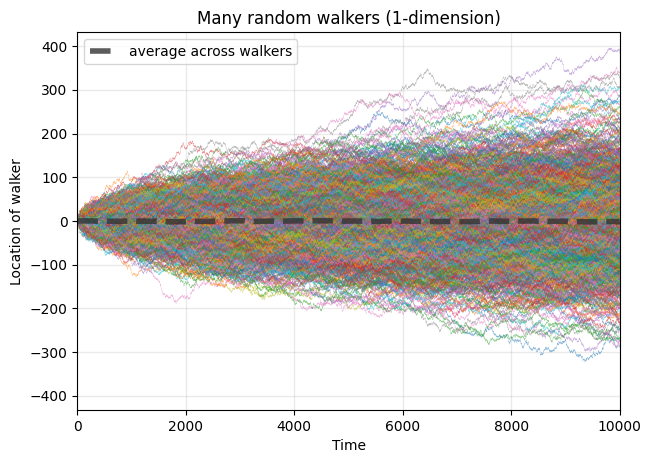
What about multiple random walkers?#
def random_walk_1d(n_walkers=1, t=10000, start_position=0, p_up=0.5):
    """
    Simulates the path of a single random walker on a 1-dimensional lattice.

    Parameters
    ----------
    n_walkers : int, optional

    t : int, optional
        The number of steps the random walker will take.
    start_position : int, optional
        The starting position of the walker on the lattice. Default is 0.
    p_up : float, optional
        The probability that the walker takes an `up` step. 0.5 indicates
        an unbiased random walker.

    Returns
    -------
    positions_over_time: vector of ints
        A list-like object representing the positions of the walker at each
        step, starting from the initial position.

    Notes
    -----
    - At each step, the walker moves either +1 (up) or -1 (down) with equal
      probability.
    - This random walk is unbiased, with each step being independent of the
      previous one.

    Examples
    --------
    >>> random_walk_1d(5, start_position=0)
    [0, 1, 0, 1, 2, 1]
    """

    all_walkers = []

    for _ in range(n_walkers):
        # Generate random steps (-1, 0, or 1) for both up and down directions
        directions = np.random.choice([-1, 1],
                                      size=(t, 1),
                                      p=[1-p_up, p_up])

        # Compute the cumulative sum to get the position at each step
        positions_over_time = np.cumsum(directions, axis=0)

        all_walkers.append(positions_over_time.T[0])

    if n_walkers == 1:
        return positions_over_time

    else:
        return np.array(all_walkers)
timesteps = 10000
n_iter = 1000
up_prob = 0.5
walkers = random_walk_1d(n_walkers=n_iter, t=timesteps, start_position=0, p_up=up_prob)
fig, ax = plt.subplots(1,1,figsize=(7,5),dpi=100)

averages = []
maxes = []

for walker in walkers:
    ax.plot(walker, lw=0.25, alpha=0.5)
    averages.append(list(walker))
    maxes.append(max(walker))

ax.plot(np.array(averages).mean(axis=0),color='.2',lw=4,alpha=0.8,ls='--',
        label='average across walkers')

ax.legend(loc=2)
ax.set_ylabel('Location of walker')
ax.set_xlabel('Time')
ax.grid(alpha=0.2, color='.6', lw=1)
ax.set_title('Many random walkers (1-dimension)')

ylims = ax.get_ylim()
ax.set_ylim(-np.abs(ylims).max(), np.abs(ylims).max())
ax.set_xlim(-1, timesteps+1)


plt.show()
Question: How does the standard deviation of walkers’ locations change over time?#
standard_devs = np.array(averages).std(axis=0)

fig, ax = plt.subplots(1,1,figsize=(7,5),dpi=100)

ax.loglog(standard_devs, color='.2', lw=2, alpha=0.8, label='computed standard deviations')

ax.loglog(np.sqrt(list(range(1,timesteps))),lw=2,color='orange',ls='--', label=r'$\sqrt{N}$')

ax.legend(loc=2)
ax.set_ylabel('Standard deviation of walker location')
ax.set_xlabel('Time')
ax.grid(alpha=0.2, color='.6', lw=1)
ax.set_title("Std. dev. of many random walkers's positions (1-dimension)")


plt.show()
Question: What is the distribution of the maximum value of each walker’s trajectory?#
fig, ax = plt.subplots(1,1,figsize=(7,5),dpi=100)

ax.hist(maxes, bins=30, density=True, ec='w', color='.2')

ax.set_ylabel('Density')
ax.set_xlabel('Maximum walker position')
ax.grid(alpha=0.2, color='.6', lw=1)
ax.set_title("Distribution of walkers' maximum positions")
ax.set_xlim(-1, max(maxes)+1)


plt.show()
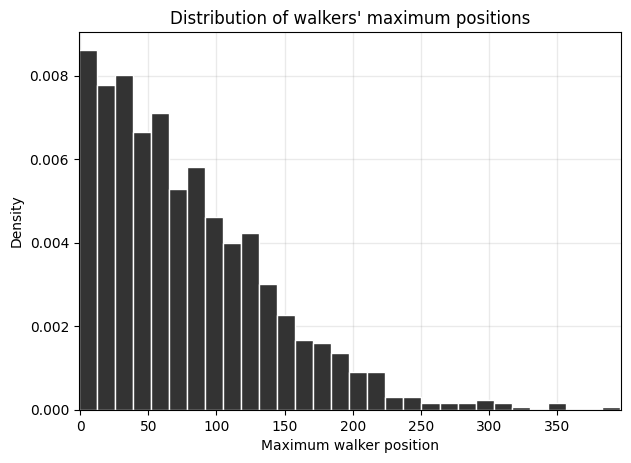
Bonus: Search a bit about the properties of the distribution of random walkers’ final positions — it’s a key concept from statistics!
# import numpy as np
# import matplotlib.pyplot as plt
# from scipy.stats import gumbel_r

# # parameters
# n_walkers = 10_000   # number of walkers per run
# t = 10_000           # steps per walker
# n_repeats = 100     # number of repeated experiments

# max_across_walkers = []
# for i in range(n_repeats):
# #     print(i)
#     # simulate many walkers and record their *final positions*
#     steps = np.random.choice([-1,1], size=(n_walkers, t))
#     positions = steps.cumsum(axis=1)

#     final_positions = positions[:,-1]  # final X_t for each walker per experiment
#     max_across_walkers_i = final_positions.max()
#     max_across_walkers.append(max_across_walkers_i)

# # theoretical parent scale: s ≈ sqrt(t)
# s = np.sqrt(t)
# N = n_walkers

# # normalization for Gumbel limit
# mu_N = s * np.sqrt(2*np.log(N)) - s * (np.log(np.log(N)) + np.log(4*np.pi)) / (2*np.sqrt(2*np.log(N)))
# beta_N = s / np.sqrt(2*np.log(N))


# # normalized variable

# max_across_walkers = np.array(max_across_walkers)
# Z = (max_across_walkers - mu_N) / beta_N


# # --- plot histogram vs Gumbel pdf
# xs = np.linspace(Z.min(), Z.max(), 400)
# plt.hist(Z, bins=40, density=True, alpha=0.7, ec='w', color='.3', label='Empirical')
# plt.plot(xs, gumbel_r.pdf(xs), lw=2, label='Gumbel(0,1)')
# plt.xlabel(r'$Z = (Y_N - \mu_N)/\beta_N$')
# plt.ylabel('Density')
# plt.title('Extreme (max-across-walkers) distribution → Gumbel')
# plt.legend()
# plt.grid(alpha=0.3)
# plt.show()
Random walks in 2-dimensions (still not networks yet!)#
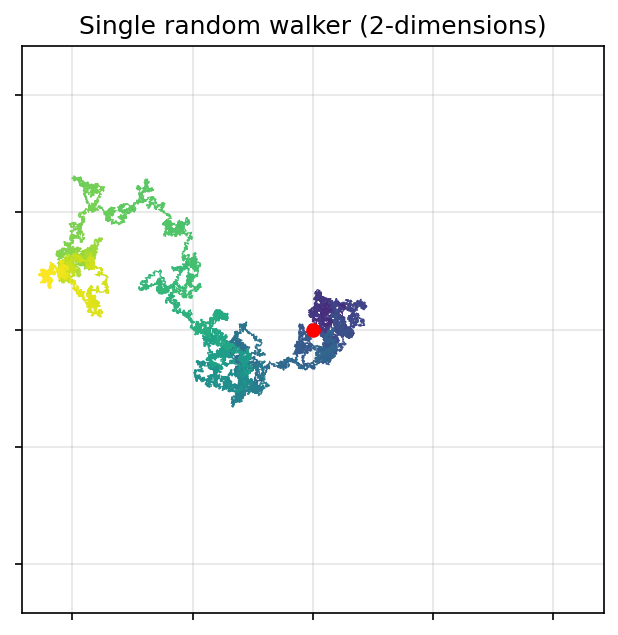
In the two-dimensional random walk, we imagine a walker starting at an origin point \((x,y) = (0,0)\) on a 2-D integer lattice, where each point corresponds to a coordinate. At each timestep, \(t\), a walker moves randomly up / down / left / right with equal probability \(P(\textrm{up}) = P(\textrm{down}) = P(\textrm{left}) = P(\textrm{right}) = \frac{1}{4}\).
There are similarities here to the 1-D walkers, such that the expected position of the walker will be
where \( \eta_{x,i} \) and \( \eta_{y,i} \) are random variables representing the steps in the \( x \) and \( y \) directions, respectively. Each of these steps is uniformly distributed over {-1, 1}.
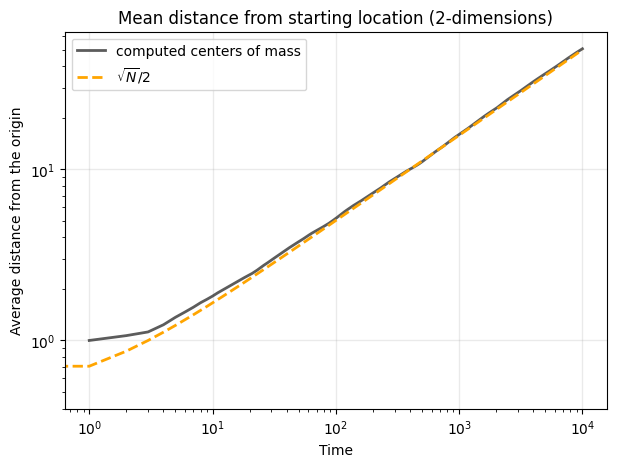
Similar to the one-dimensional case, the expected position of the walker remains at the origin: \(E[X_t] = E[Y_t] = 0\). The variance of each coordinate grows linearly with time, as in the one-dimensional case. However, the combined radial distance from the origin \( R_t = \sqrt{X_t^2 + Y_t^2} \) is an important quantity that provides a measure of the walker’s spread in two dimensions. The expected value of \( R_t \) grows as \(E[R_t] \approx \sqrt{t}\) indicating diffusive behavior in two dimensions, with the walker’s distance from the origin increasing proportionally to the square root of time.
2-D random walks are also used to study many processes, from the movement of particles in a fluid (Brownian motion) to animal foraging behavior. This section introduces the two-dimensional random walk as a stepping stone to more complex random walks on networks, where the underlying structure influences the walker’s movement in ways that go beyond free-space diffusion.
# Set random seed for reproducibility
# np.random.seed(10)

# Parameters
num_steps = 100000  # Number of steps in the random walk

# Initialize starting position (at origin)
x = np.zeros(num_steps)
y = np.zeros(num_steps)

# Perform the random walk
for i in range(1, num_steps):
    direction = np.random.choice(['up', 'down', 'left', 'right'])  # Choose a direction randomly
    if direction == 'up':
        y[i] = y[i - 1] + 1
        x[i] = x[i - 1]
    elif direction == 'down':
        y[i] = y[i - 1] - 1
        x[i] = x[i - 1]
    elif direction == 'left':
        x[i] = x[i - 1] - 1
        y[i] = y[i - 1]
    else:  # 'right'
        x[i] = x[i - 1] + 1
        y[i] = y[i - 1]
rc('axes', fc='w')
rc('figure', fc='w')
rc('savefig', fc='w')

fig, ax = plt.subplots(1,1,figsize=(5,5),dpi=150,sharex=True,sharey=True)
plt.subplots_adjust(wspace=0.05)

# Plot the random walk path
ax.scatter(x, y, c=np.linspace(0.1,1,len(x)), marker='.', s=1, lw=0, cmap='viridis', vmin=0, vmax=1)
ax.scatter(0, 0, color='red')
ax.tick_params(axis='both',labelbottom=False,labelleft=False)
ax.grid(alpha=0.2, color='.6', lw=1)
xlims = ax.get_xlim()
ylims = ax.get_ylim()
max_lim = max(max(np.abs(xlims)),max(np.abs(ylims)))
ax.set_ylim(-max_lim,max_lim)
ax.set_xlim(-max_lim,max_lim)
ax.set_title('Single random walker (2-dimensions)')


plt.show()
def random_walk_2d(n_walkers=1, t=10000, start_position=(0, 0), p_move=0.25):
    """
    Simulates the path of one or more random walkers on a 2-dimensional lattice.

    Parameters
    ----------
    n_walkers : int, optional
        The number of random walkers to simulate. Default is 1.
    t : int, optional
        The number of steps each random walker will take. Default is 10000.
    start_position : tuple of ints, optional
        The starting (x, y) position of each walker on the lattice. Default is (0, 0).
    p_move : float, optional
        The probability for each direction (up, down, left, right). Default is 0.25,
        indicating an unbiased random walker.

    Returns
    -------
    positions_over_time : numpy.ndarray
        An array representing the positions of each walker at each step. Shape is
        (n_walkers, t, 2), where each entry is the (x, y) position at each time step.

    Notes
    -----
    - Each step moves the walker either up, down, left, or right with equal probability.
    - This random walk is unbiased, with each step being independent of previous steps.

    Examples
    --------
    >>> random_walk_2d(n_walkers=1, t=5, start_position=(0, 0))
    array([[[0, 0],
            [0, 1],
            [1, 1],
            [1, 0],
            [2, 0]]])
    """

    all_walkers = []

    for _ in range(n_walkers):
        step_choices = np.random.choice([0, 1, 2, 3], size=t)
        moves = np.array([[0,1], # up
                          [0,-1], # down
                          [1,0], # right
                          [-1,0]] # left
                        )[step_choices]
        positions_over_time = np.cumsum(moves, axis=0) + np.array(start_position)
        all_walkers.append(positions_over_time)

    return np.array(all_walkers) if n_walkers > 1 else positions_over_time
t = 10000
start_position = (0,0,0)
step_choices = np.random.choice([0, 1, 2, 3, 4, 5], size=t)
moves = np.array([[0,0,1], # up
                  [0,0,-1], # down
                  [1,0,0], # right
                  [-1,0,0], # left
                  [0,1,0], # forward
                  [0,-1,0]] # backward
                )[step_choices]

positions_over_time = np.cumsum(moves, axis=0) + np.array(start_position)
fig, ax = plt.subplots(1,4,figsize=(20,5),dpi=200,sharex=True,sharey=True)
plt.subplots_adjust(wspace=0.05)
max_lims = []
cmaps = ['Greens','Blues','Reds','Purples']

# Set random seed for reproducibility
np.random.seed(5)

# Parameters
num_steps = 100000  # Number of steps in the random walk

for zz in range(len(cmaps)):

    walk = random_walk_2d(1, num_steps)
    x = walk[:,0]
    y = walk[:,1]

    # Plot the random walk path
    ax[zz].scatter(x, y, c=np.linspace(0.1,1,len(x)), marker='o',
                   s=1, lw=0, cmap=cmaps[zz], vmin=0, vmax=1)
    ax[zz].scatter(0, 0, color='red')

    ax[zz].tick_params(axis='both',labelbottom=False,labelleft=False)
    ax[zz].grid(alpha=0.2, color='.6', lw=1)
    xlims = ax[zz].get_xlim()
    ylims = ax[zz].get_ylim()
    max_lim = max(max(np.abs(xlims)),max(np.abs(ylims)))
    max_lims.append(max_lim)


max_lim = max(max_lims)
for a in fig.axes:
    a.set_ylim(-max_lim,max_lim)
    a.set_xlim(-max_lim,max_lim)

plt.suptitle('Four examples of random walker trajectories in 2-dimensions',fontsize='xx-large')


plt.show()

mean_centers = []
num_steps = 10000
runs = random_walk_2d(n_walkers=100, t=num_steps)

for i in range(runs.shape[0]):
    x = runs[i][:,0]
    y = runs[i][:,1]

    mc_i = [(np.nanmean(y[:zz])**2 + \
             np.nanmean(x[:zz])**2)**0.5 for zz in range(len(x))]
    mean_centers.append(mc_i)
/usr/local/anaconda3/envs/covid/lib/python3.8/site-packages/numpy/core/fromnumeric.py:3474: RuntimeWarning: Mean of empty slice.
  return _methods._mean(a, axis=axis, dtype=dtype,
/usr/local/anaconda3/envs/covid/lib/python3.8/site-packages/numpy/core/_methods.py:189: RuntimeWarning: invalid value encountered in double_scalars
  ret = ret.dtype.type(ret / rcount)
fig, ax = plt.subplots(1,1,figsize=(7,5),dpi=100)

ax.loglog(np.mean(mean_centers,axis=0),
          color='.2', lw=2, alpha=0.8, label='computed centers of mass')

ax.loglog(np.sqrt(list(range(1,num_steps)))/2,
          lw=2,color='orange',ls='--', label=r'$\sqrt{N}/2$')

ax.legend(loc=2)
ax.set_ylabel('Average distance from the origin')
ax.set_xlabel('Time')
ax.grid(alpha=0.2, color='.6', lw=1)
ax.set_title("Mean distance from starting location (2-dimensions)")


plt.show()
Random walks on networks#
Having explored random walks in one and two dimensions, we now extend the concept to networks! What dimension do we usually consider networks to have?
Key Concepts and Definitions#
In a network, each node has its own transition probabilities to its neighboring nodes, often determined by its degree, meaning the probability of a walker transitioning from one node to another varies according to the structure of the network. For an undirected network, we define a basic random walk as follows:
Starting Point: The walker begins at an “origin” node.
Transition Rules: At each time step, the walker moves to a neighboring node, (usually) chosen uniformly from all neighbors of the current node. This is an unbiased random walk on an undirected network.
Transition Probability: The probability of moving from node \(i\) to an adjacent node \(j\) is inversely proportional to the degree of \(i\) (i.e., \( p_{ij} = \frac{1}{k_i} \)).
Common properties to calculate with random walks#
Hitting Time: The expected time for a walker to reach a specific target node for the first time.
Return Probability: The probability that the walker will return to the origin node after a given time \(t\).
Stationary Distribution: For large \( t \), the walker’s position converges to a stationary distribution, where the probability of finding the walker at each node is stable. For an undirected network, the stationary probability \( \pi_i \) at node ( i ) is proportional to its degree, \( \pi_i = \frac{k_i}{2 E} \), where \(E\) is the number of edges.
Mixing Time: The time required for the distribution of the walker’s position to approximate the stationary distribution closely.
Applications and Relevance#
Random walks on networks serve as models for a wide range of processes, including:
Network Navigation and Search: Models how information or resources are spread or located within a network.
PageRank: Google’s PageRank algorithm uses a variant of a random walk to rank websites by their importance based on link structure.
Diffusion in Social Networks: Models information spread, where each “walker” represents the spread of ideas, memes, or infections.
This section will introduce random walks on networks through hands-on examples, providing an intuitive understanding of how different network structures influence the dynamics of the walk.
…but first… code it yourself!#
def random_walk_network(G, start_node, steps):
    """
    Simulates a random walk on a network, represented as a graph.

    Starting from the specified node, the walker moves to a randomly selected
    neighboring node at each step. If the walker reaches an isolated node (one with
    no neighbors), the walk terminates early.

    Parameters
    ----------
    G : networkx.Graph
        The graph representing the network on which the random walk is performed.
        Nodes should be connected by edges, as each edge represents a possible transition.
    start_node : node
        The node in G where the random walk starts. Must be a valid node in the graph.
    steps : int
        The number of steps the random walker will attempt to take. Note that the walk
        may terminate early if an isolated node is reached.

    Returns
    -------
    path : list
        A list of nodes representing the path taken by the walker, starting from
        `start_node`. The list length will be `steps + 1` unless the walk terminates early
        at an isolated node.

    Notes
    -----
    - At each step, the walker chooses a neighboring node uniformly at random.
    - If the walker reaches an isolated node (one with no neighbors), the walk stops early.
    - This function assumes the graph `G` is undirected, but it can be adapted for
      directed networks by modifying the neighbor selection.

    Examples
    --------
    >>> G = nx.path_graph(5)  # Simple path graph with 5 nodes
    >>> random_walk_network(G, start_node=0, steps=10)
    [0, 1, 2, 1, 2, 3, 2, 1, 0, 1, 2]
    """
    # Initialize the path list with the starting node

    pass


    return path  # Return the full path taken by the walker
G = nx.karate_club_graph()
(don’t look below please)
def random_walk_network(G, start_node, steps):
    """
    Simulates a random walk on a network, represented as a graph.

    Starting from the specified node, the walker moves to a randomly selected
    neighboring node at each step. If the walker reaches an isolated node (one with
    no neighbors), the walk terminates early.

    Parameters
    ----------
    G : networkx.Graph
        The graph representing the network on which the random walk is performed.
        Nodes should be connected by edges, as each edge represents a possible transition.
    start_node : node
        The node in G where the random walk starts. Must be a valid node in the graph.
    steps : int
        The number of steps the random walker will attempt to take. Note that the walk
        may terminate early if an isolated node is reached.

    Returns
    -------
    path : list
        A list of nodes representing the path taken by the walker, starting from
        `start_node`. The list length will be `steps + 1` unless the walk terminates early
        at an isolated node.

    Notes
    -----
    - At each step, the walker chooses a neighboring node uniformly at random.
    - If the walker reaches an isolated node (one with no neighbors), the walk stops early.
    - This function assumes the graph `G` is undirected, but it can be adapted for
      directed networks by modifying the neighbor selection.

    Examples
    --------
    >>> G = nx.path_graph(5)  # Simple path graph with 5 nodes
    >>> random_walk_network(G, start_node=0, steps=10)
    [0, 1, 2, 1, 2, 3, 2, 1, 0, 1, 2]
    """
    # Initialize the path list with the starting node
    path = [start_node]

    # Set the current node to the starting node
    current_node = start_node

    # Iterate for the specified number of steps
    for _ in range(steps):
        # Get the list of neighbors of the current node
        neighbors = list(G.neighbors(current_node))

        # If the current node has neighbors, move to a randomly chosen neighbor
        if neighbors:
            next_node = np.random.choice(neighbors)  # Select a random neighbor
            path.append(next_node)  # Append the selected neighbor to the path
            current_node = next_node  # Update the current node
        else:
            # If no neighbors (isolated node), terminate the walk early
            break


    return path  # Return the full path taken by the walker
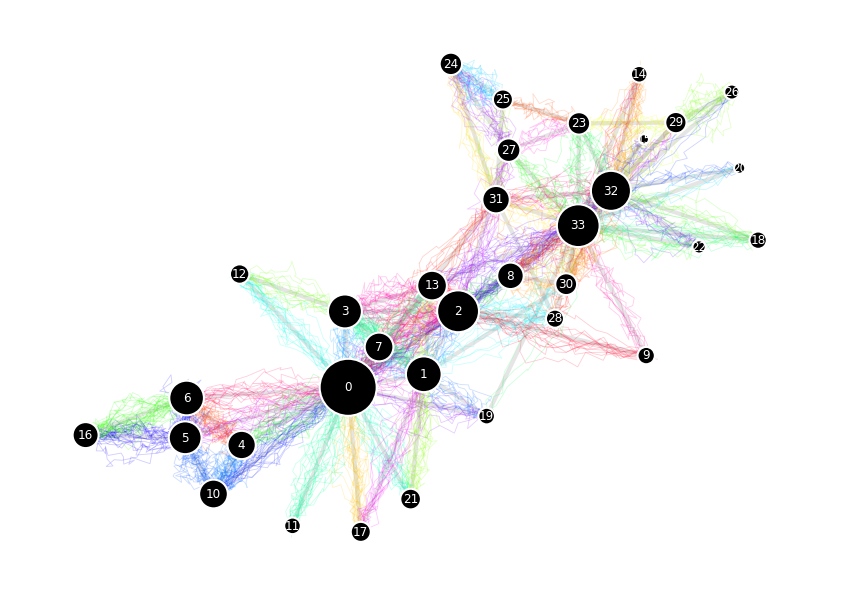
np.random.seed(2)
G = nx.karate_club_graph()
pos = nx.spring_layout(G)  # Layout for node positions
pos[33] = np.array([0.28, 0.16])
pos[13] = np.array([-0.09983414, 0.01])
from collections import Counter

len_path = 1000
edge_cols = plt.cm.hsv(np.linspace(0,1,G.number_of_edges()))
np.random.seed(1)
np.random.shuffle(edge_cols)
edge_colors2 = {(i[0],i[1]):edge_cols[ix] for ix, i in enumerate(G.edges())}
edge_colors = {(i[1],i[0]):edge_cols[ix] for ix, i in enumerate(G.edges())}
edge_colors.update(edge_colors2)

path = random_walk_network(G, 0, len_path)

node_visits = {i:dict(Counter(path))[i] for i in G.nodes()}
node_sizes = {i:750*j/max(node_visits.values()) for i,j in node_visits.items()}

xvals_path = list(list(zip(*[pos[i] for i in path]))[0])
yvals_path = list(list(zip(*[pos[i] for i in path]))[1])

xvals = list(list(zip(*[pos[i] for i in G.nodes()]))[0])
yvals = list(list(zip(*[pos[i] for i in G.nodes()]))[1])

fig, ax = plt.subplots(1,1,figsize=(7,5),dpi=150)

cols = plt.cm.viridis(np.linspace(0,1,len_path))
path_wiggle_n = 20
path_wiggle_var = 0.01


for i in range(len_path-1):
    start_xi = xvals_path[i]
    end_xi = xvals_path[i+1]
    col_i = edge_colors[(path[i],path[i+1])]

    ogx = np.linspace(start_xi, end_xi, path_wiggle_n)
    og2x = ogx.copy()

    og2x_first = list(np.linspace(ogx[0], ogx[int(path_wiggle_n/2)] + np.random.normal(0,path_wiggle_var*3),
                                 int(path_wiggle_n/2)))
    og2x_second = list(np.linspace(og2x_first[-1], ogx[-1], int(path_wiggle_n/2)))
    path_plot_xi = np.array(og2x_first+og2x_second) + np.random.normal(0, path_wiggle_var, path_wiggle_n)


    start_yi = yvals_path[i]
    end_yi = yvals_path[i+1]
    ogy = np.linspace(start_yi, end_yi, path_wiggle_n)
    og2y = ogy.copy()

    og2y_first = list(np.linspace(ogy[0], ogy[int(path_wiggle_n/2)] + np.random.normal(0,path_wiggle_var*3),
                                 int(path_wiggle_n/2)))
    og2y_second = list(np.linspace(og2y_first[-1], ogy[-1], int(path_wiggle_n/2)))
    path_plot_yi = np.array(og2y_first+og2y_second) + np.random.normal(0, path_wiggle_var, path_wiggle_n)


    ax.plot(path_plot_xi, path_plot_yi, alpha=0.2, color=col_i, lw=0.4)

nx.draw_networkx_nodes(G, pos, node_color='k', node_size=list(node_sizes.values()), ax=ax, edgecolors='w')
nx.draw_networkx_edges(G, pos, edge_color='.5', width=2, ax=ax, alpha=0.2)
nx.draw_networkx_labels(G, pos, font_color='w', ax=ax, font_size='xx-small')

# ax.scatter(xvals,yvals, c='k',s=list(node_sizes.values()),zorder=20,ec='w')

ax.set_axis_off()

plt.show()
Random walk cover time on networks#
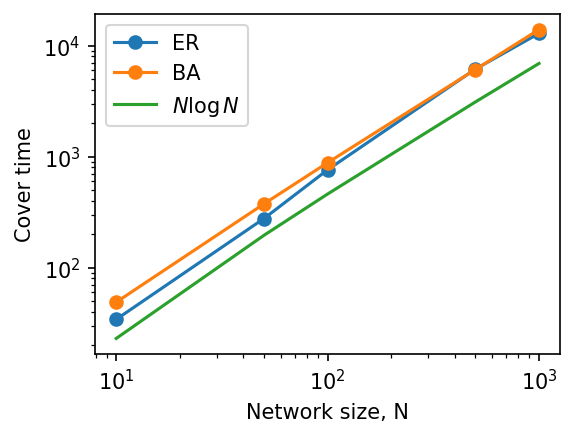
The cover time is the expected number of steps to reach every node, starting from a given initial distribution.
import random
def random_walk_coverage_time(G, start_node=None):
    """
    Simulates a random walk on a network to determine the time taken to cover all nodes.

    Starting from a specified or random node, the walker moves to a randomly chosen
    neighboring node at each step. The walk continues until all nodes in the graph
    have been visited at least once.

    Parameters
    ----------
    G : networkx.Graph
        The graph representing the network on which the random walk is performed.
    start_node : node, optional
        The node where the random walk starts. If None, a random node is chosen.

    Returns
    -------
    coverage_time : int
        The number of steps required to visit every node in the graph at least once.
    path : list
        A list of nodes representing the path taken by the walker.

    Notes
    -----
    - This function assumes the graph `G` is undirected and connected.
    - If the graph has isolated components, some nodes may remain unvisited.

    Examples
    --------
    >>> G = nx.path_graph(5)
    >>> random_walk_coverage_time(G)
    (7, [2, 1, 0, 1, 2, 3, 4])
    """

    # Initialize the starting node
    source = start_node if start_node is not None else random.choice(list(G.nodes))
    nodes_covered = set([source])  # Track visited nodes
    path = [source]                # Track the path of the walker
    N = G.number_of_nodes()        # Total number of nodes in the graph
    t = 0                          # Step counter

    if not nx.is_connected(G):
        return 'help',[]
#         print('Help')

    # Continue walking until all nodes have been visited
    while len(nodes_covered) < N:
        # Get the neighbors of the current node
        neighbors = list(G.neighbors(source))

        # Choose a random neighbor and move there
        target = random.choice(neighbors)
        path.append(target)
        nodes_covered.add(target)  # Add the new node to the visited set
        source = target            # Update the current node
        t += 1                     # Increment the step count

    return t, path  # Return the time to cover all nodes and the path taken
How does cover time vary by network + size + structure?#
Simulate 10 BA networks of size [10, 50, 100, 500, 1000] with m = 6, and measure their average cover times.
Simulate 10 ER networks of same size and density, and measure their average cover times.
# Ns = np.logspace(1, 3, 20)
Ns = [10, 50, 100, 500, 1000]
m = 6
n_iter = 100

cover_ba = []
cover_er = []

for N in Ns:
    N = int(N)
    print(N)
    cover_ba_n = []
    cover_er_n = []
    for _ in range(n_iter):
        G_ba = nx.barabasi_albert_graph(N, m)
        cover_t_ba, _ = random_walk_coverage_time(G_ba)
        cover_ba_n.append(cover_t_ba)

        G_er = nx.erdos_renyi_graph(N, nx.density(G_ba))
        cover_t_er, _ = random_walk_coverage_time(G_er)
        if not cover_t_er == 'help':
            cover_er_n.append(cover_t_er)

    cover_ba.append(np.mean(cover_ba_n))
    cover_er.append(np.mean(cover_er_n))
10
50
100
500
1000
fig, ax = plt.subplots(1,1,figsize=(4,3),dpi=150)

ax.loglog(Ns, cover_er, 'o-', label='ER')
ax.loglog(Ns, cover_ba, 'o-', label='BA')
ax.loglog(Ns, [N*np.log(N) for N in Ns], label=r'$N \log N$')

ax.legend()
ax.set_xlabel('Network size, N')
ax.set_ylabel('Cover time')

plt.show()
If there’s time: Work in pairs to code the mean first passage time in a network#
We often focus on the stationary distribution of a random walk on a network: in the long run, what fraction of time does the walker spend at each node? Many applications, however, are not about “where the walker lives in the long run” but about how long it takes to reach something. Examples:
how long it takes information to reach a particular server in a network;
how long it takes a random walker to reach a “target” node (a hospital, a charging station, a hub airport);
how long it takes until the weather changes from rainy to sunny.
These questions are captured by the mean first passage time (MFPT) (also called the mean hitting time).
Definition: hitting time and mean first passage time#
Consider a random walk on a graph with transition matrix \(\mathbf{P}\), where \(P_{ij}\) is the probability of moving from node \(i\) to node \(j\) in one step. Let \(\{X_t\}_{t \ge 0}\) denote the Markov chain describing the walker’s position, so that \(X_t \in \{1,\dots,N\}\).
For two nodes \(i\) and \(j\), the hitting time of \(j\) starting from \(i\) is the random variable
The mean first passage time (MFPT) from \(i\) to \(j\) is then
By convention, \(T_{ii}\) is the mean return time to node \(i\).
MFPTs characterize the short- to medium-term dynamics of a random walk: they tell us how quickly information, agents, or contagions can reach a given node. This contrasts with the stationary distribution, which only quantifies the long-run visitation frequencies.
Stationary distribution and a simple approximation#
Assume the graph is connected and undirected, with a standard random walk
where \(A_{ij}\) is the adjacency matrix and \(k_i\) is the degree of node \(i\).
The stationary distribution is
A classical result (Kac’s lemma) states that the mean return time to node \(j\) is
A useful heuristic: once the walk has mixed, visits to node \(j\) behave approximately like Bernoulli trials with success probability \(\pi_j\). Thus the probability that the first visit occurs at step \(n\) is approximately
leading to the expectation
For undirected graphs this yields the familiar scaling:
meaning high-degree nodes are reached quickly, while low-degree nodes tend to be harder to hit.
Exact MFPTs from a linear system#
For coding, a very practical way to compute MFPTs is to use the backwards equation. Fix a target node \(j\). For each node \(i\), the MFPT \(T_{ij}\) satisfies
Intuition: if you start at node \(i \neq j\), you pay one step to move somewhere, and then you still need the expected time from wherever you land.
To use this in code, we treat the \(N-1\) unknowns \(\{T_{ij}\}_{i \neq j}\) as a vector and write the equations in matrix form. Remove the row and column corresponding to \(j\) from \(\mathbf{P}\), giving an \((N-1)\times(N-1)\) matrix \(\mathbf{P}^{(j)}\). Let \(\mathbf{t}^{(j)}\) be the vector of MFPTs to \(j\) from all \(i \neq j\), and let \(\mathbf{1}\) be an \((N-1)\)-dimensional vector of ones. Then the equations above become
Rearranging,
so that
This is an \((N-1)\times(N-1)\) linear system that you can solve numerically with standard linear algebra tools.
MFPTs, generalized inverses, and the fundamental matrix (optional)#
For a compact matrix expression, let \(\mathbf{T}\) be the full matrix of MFPTs, with entries \(T_{ij}\). Let \(\boldsymbol{\pi}\) be the stationary distribution, written as a row vector, and let \(\mathbf{1}\) be the all-ones column vector.
Define the fundamental matrix:
One can show:
and
Alternatively, with \(\mathbf{F} = \mathbf{I} - \mathbf{P}\) and \(\mathbf{F}^{\#}\) its group inverse,
with \(T_{jj} = 1/\pi_j\) as before.
These formulations connect MFPTs to deeper linear-algebraic structures, including generalized inverses and the spectrum of the graph Laplacian.
Next time…#
Dynamics 2 — Compartmental Models and Spreading Processes class_17_dynamics2.ipynb
References and further resources:#
Class Webpages
Jupyter Book: https://network-science-data-and-models.github.io/phys7332_fa25/README.html
Github: https://github.com/network-science-data-and-models/phys7332_fa25/
Syllabus and course details: https://brennanklein.com/phys7332-fall25
Masuda, Porter, & Lambiotte (2017). Random walks and diffusion on networks. Physics Reports, 716, 1-58. https://doi.org/10.1016/j.physrep.2017.07.007
The cover time of sparse random graphs - https://doi.org/10.1002/rsa.20151
Meyer, Jr, C. D. (1975). The role of the group generalized inverse in the theory of finite Markov chains. Siam Review, 17(3), 443-464. https://epubs.siam.org/doi/10.1137/1017044
Cho, G. E., & Meyer, C. D. (2001). Comparison of perturbation bounds for the stationary distribution of a Markov chain. Linear Algebra and its Applications, 335(1-3), 137-150. https://www.sciencedirect.com/science/article/pii/S0024379501003202
L. Lovász, “Random walks on graphs: A survey,” in Combinatorics, Paul Erdős is Eighty, Vol. 2, 1996. https://cs.yale.edu/publications/techreports/tr1029.pdf
Barrat, A., Barthelemy, M., & Vespignani, A. (2008). Dynamical Processes on Complex Networks. Cambridge University Press.